

The Pacific halibut fishery ended on Dec. 7, and by all accounts, things remained on a stagnant trend. Stakeholders are dealing with the fallout from the lowest Pacific halibut spawning biomass in 40 years, and harvesters widely reported catches of fewer and smaller fish.
The annual survey conducted since 1963 by the International Pacific Halibut Commission (IPHC) revealed little change in the halibut stock that stretches from Alaska’s northern Bering Sea, British Columbia, Washington, Oregon to California’s Monterey Bay.
According to a report by the IPHC at its interim meeting on December 2, total halibut takes (called mortalities) from all sectors – commercial, sport, personal use, and subsistence – were 28.8 million pounds, down 12% from last year, and marking the lowest removals in 100 years.
Alaska always gets the bulk of the big flatfish, and projected 2025 landings at all ports through December 7 were pegged at 11,715,646 pounds, which is 22 percent below the statewide commercial fishery limit for 2025.
A fisheries overview showed that landings were down at all Alaska ports.
Halibut deliveries dropped by 16 percent for Area 2C (Southeast Alaska), by 8% for Area 3A (Central Gulf of Alaska), and 12 percent for Area 3B (Western Gulf). The biggest declines came from further west, with catches declining 33 percent for Area 4A (Aleutians region), 78 percent for Area 4B (Bering Sea) and 57 percent for 4CDE (Bering Sea).
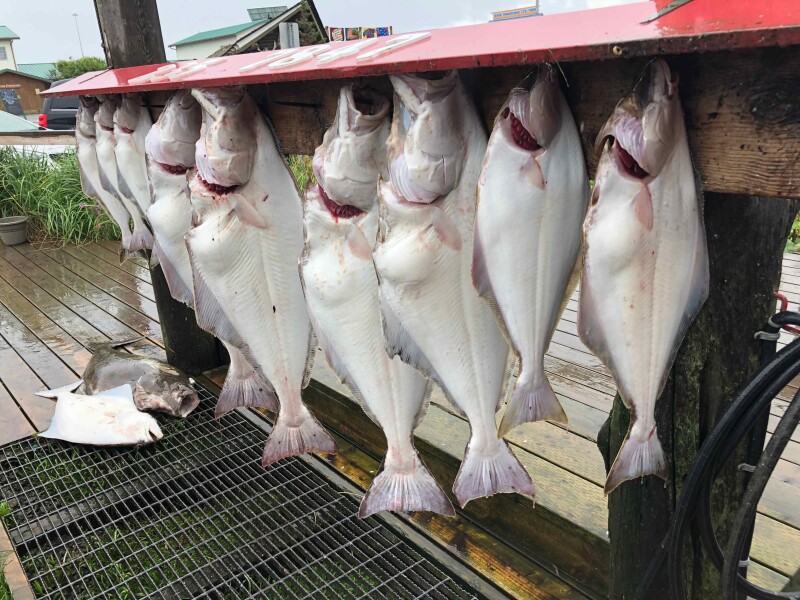
Homer was again the leading port for halibut landings, receiving approximately 24 percent (2,765,482 pounds) of the total Alaska commercial catch. Kodiak received the second largest landing volume at 14 percent (1,619,044 pounds), followed by Petersburg and Sitka, with their combined landings representing 15 percent of the catch limit at 1,758,762 pounds.
Halibut bycatch, called “discard mortality in non-directed fisheries,” was estimated to be 4.6 million pounds in 2025, up 6 percent from 2024 and representing the highest estimate since 2019.
A total of 2,206 fishermen holding quota shares of halibut participated during the season that opened on March 20.
Prices to fishermen dropped at the end of the fishery ranging from $5 to over $6.50 per pound, down from as high as $8 in previous months.
Downward trend for more than a decade
The downward trend for a decade has been sobering for stakeholders and fisheries managers, some years going slightly up, some years down.
“Historically, the species may be the most consistently studied fish in the world, with landings data going back more than a century. The fish are long-lived and more adaptable than most species. The fishery is currently in a “not overfished” condition, with no overfishing happening,” wrote Peggy Parker at Seafoodnews.com.
Fishery managers believe the halibut decline is likely due to two dynamics — a loss of weight at age and a lack of recruitment. They pointed out that 50 years ago, a 16-year-old female halibut weighed an average of 75 pounds while today, that fish weighs under 30 pounds.
The IPHC Annual Meeting is scheduled in person from January 19-22, 2026 in Bellevue, Washington. That’s when the annual catch limits for 2026 will be announced.
Find the Annual Meeting agenda and documents HERE