The dory is the iconic fishing vessel of New England and the Canadian Maritimes. Whether launched from a schooner on the Grand Banks or rowed out of a little gunkhole harbor on the coast of New England, in the late 1800s and early 1900s most seafood in the region came over the rail of a dory.
So, it was fitting when Sarah LeWine and Jim Tarantino decided to row a dory from Gloucester, Nova Scotia.
“I was in the International Dory Association in Gloucester,” says Sarah. “I had been rowing for a couple of years out to the breakwater with my first dorymate, a woman, and I always wanted to go further. I started to imagine a trip up the coast of Maine, but I couldn’t think of anyone who also wanted to do that.”
“And then when Jimmy and I became mixed double race partners and started practicing, we went out to the breakwater and I said, What I really want to do is row up the coast of Maine. He told me he’d been planning to row up the coast and over to Nova Scotia, and asked if I wanted to go. I said, yeah!”
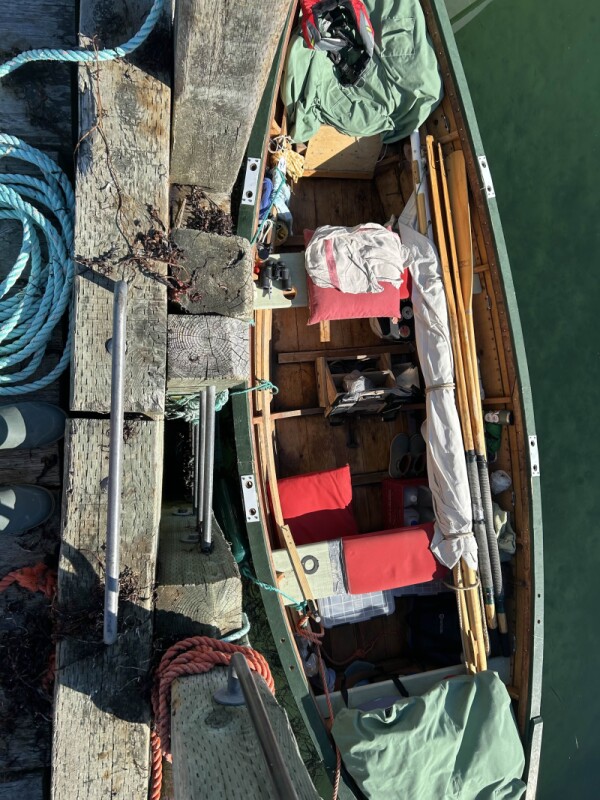
Tarantino is a members of Gloucester’s International Dory Association, a club that keeps the spirit of the dory alive in one of America’s most famous fishing towns. For the trip, Tarantino purchased a 20-foot dory with a 5.5-foot beam from the Big Boat Shed in Lunenburg, Nova Scotia, and named it the Heart of Gloucester. The pair spent nine months planning and preparing, including having a custom tent built to go over the top of the dory.
“That was the best $3,000 we spent,” says Tarantino, adding that they only slept on land three times over the course of their 24-day journey. “We had so much stuff in the boat that we could just put our sleeping pads on top of it. I had a spot in the bow and Sarah had a spot in the stern.”
But they didn’t do much sleeping. “We rowed about 20 hours a day, what else are you going to do?” says Tatentino.
LeWine and Tarantino rowed up the coast of Maine, stopping all along the way. “People were so kind to us everywhere,” says LeWine. “We got to Frenchboro and left there on Aug. 6 to cross the Gulf of Maine, 120 miles.”
Tarantino had imagined crossing in 48 hours, but in turned into three and a half days, with the effects of Hurricane Erin on the currents sending them up towards the Bay of Fundy. That caused some squabbles in the little boat. “He wanted me to just trust him. I wanted to know where we were and where we were going,” says LeWine.
“We realized we were going east, and Sarah said, okay, let’s just go east. So, I said, okay,” says Tarantino, who found himself so tired on the crossing that he started hallucinating. “I thought I was with someone else. I was calling her the wrong name.”
They struck Nova Scotia at Cape Forchu, well north of their intended landing point near Yarmouth, and worked the ebb tides down around the southwest tip of the peninsular province. Heading northeast towards Lunenburg, LeWine reports they had the scariest experience on the journey.
“I said, Jimmy, I think these waves are getting bigger. He said, no, they’re not. But after a few hours, we found ourselves rowing in six to eight-foot seas, close together; we’d be going down one and slam hard into the next. I thought we might die.”
LeWine remembers that Tarantino kept his composure and focused on meeting the waves and keeping them from getting swamped. “I didn’t have time to think about anything else,” says Tarantino.
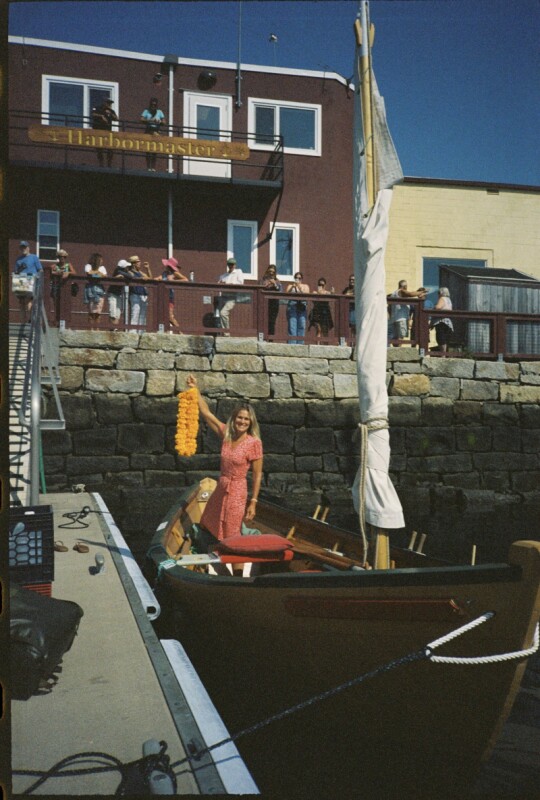
Overall, LeWine and Tarantino were lucky. Aside from a couple of days, the weather was fair, and out on the big crossing, at night, rowing under the stars, LeWine felt they were having a mystical experience. They made it into another famous fishing town, Lunenburg, on Aug. 19, a week ahead of when they expected.