




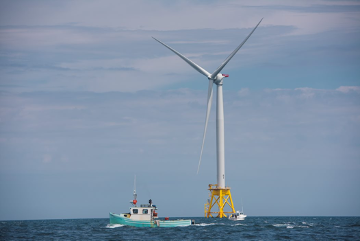
Wind power company Ørsted and the states of Rhode Island and Connecticut filed lawsuits in federal court to overturn the Trump administration’s shutdown of the Revolution Wind project, arguing the government is using spurious arguments to withdraw permits for the $5 billion project, already 80 percent complete.
“With zero justification, Trump wants to mothball the project, send workers home, and saddle Connecticut families with millions of dollars in higher energy costs,” Connecticut Attorney General Tong said in a statement when the lawsuits were filed Sept. 4. “This kind of erratic and reckless governing is blatantly illegal, and we’re suing to stop it.”
Ørsted had made its intention clear when the federal Bureau of Ocean Energy Management cited national security Aug. 22 as the reason for the agency’s sudden decision to review the project despite previous approvals under the Biden administration.
“Ørsted is evaluating all options to resolve the matter expeditiously,” including court action, the company said then. In arguments presented Thursday to the District Court for the District of Columbia, the company called the stop-work order arbitrary, capricious, unlawful and “issued in bad faith.”
With a partner Skyborn Renewables, there is $5 billion invested in Revolution Wind already, and the partners stand to take another $1 billion hit if the project is stopped, according to the developers’ lawyers.
In their separate lawsuit in federal District Court for Rhode Island, Rhode Island and Connecticut officials say the Trump administration’s action through the Bureau of Ocean Energy Management “did not identify any violation of law or imminent threat to safety. The order abstractly cites BOEM’s authority under the Outer Continental Shelf Lands Act (OCSLA), ordering the stop so that the agency may address unidentified ‘concerns.’”
The complaint against the Department of the Interior and BOEM says the stop-work order violates the Administrative Procedure Act and OCSLA. Both laws “demand reasoned decision-making, fidelity to statutory limits, and respect for the settled expectations of sovereign states and regulated parties,” the complaint states. “The States of Connecticut and Rhode Island sue to vindicate those principles. They seek to restore the rule of law, protect their energy and economic interests, and ensure that the federal government honors its commitments.”
The lawsuits attempt to slow the Trump campaign to block almost all renewable energy development projects where possible, using tactics that industry advocates and five Democratic Northeast state governors call illegal.
Revolution Wind has long been vigorously opposed by the commercial fishing industry for its siting near Cox Ledge, an important habitat for cod. In 2023 fishermen’s fierce opposition led to the mass resignation of the Rhode Island Fishermen’s Advisory Board, whose members charged the state Coastal Resource Management Council is too deferential to wind development interests at the expense of habitat and fisheries impacts.
The Trump administration’s sweeping actions are helping fishermen and other project opponents feel vindicated. Rhode Island politicians, deeply committed to renewable energy since the five-turbine Block Island Wind Farm project was built in 2016, see the reversal as a threat to that investment.
The states are feeling the sting of the administration cancelling $679 million in ports and infrastructure spending that would have supported offshore wind development. As Rhode Island and Connecticut were launching their joint lawsuit Sept. 4, Sen. Sheldon Whitehouse, D-R.I., moved to block the nomination of Sean McMaster as Federal Highway Administration administrator over the termination of $11.25 million funding for the Port of Davisville at the Quonset Business Park.
“These upgrades would have improved and modernized the port, created more well-paying union jobs, improved security, expanded capacity for growth, and spurred future investments,” said Whitehouse. “This bad faith decision was a punch in the face to Rhode Island’s premier port, and I cannot support McMaster’s nomination until this funding is restored.”
The project was to be funded through the Department of Transportation Port Infrastructure Development Program to rehabilitate the North Berth at Pier 1. But it fell victim to the administration move to withdraw all grant funds for wind power-related projects.

 (1).jpg.small.400x400.jpg)
