

Greenland has been much in the news since the Trump administration announced its desire to control the world’s largest island. While geographically part of North America (as is western Iceland), Greenland is a semi-autonomous region under the control of Denmark and is politically and economically aligned with the European Union. The EU pays Greenland over $20 million annually for access and support of Greenland’s fisheries.
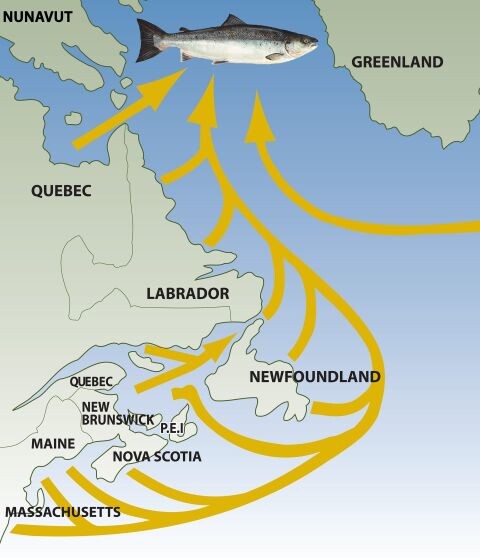
While seafood products including halibut, shrimp, and mackerel account for well over 90 percent of Greenland’s exports, Greenland seldom makes the fisheries news in North America. Yet several North American stocks migrate to Greenland waters, most notably Atlantic salmon and bluefin tuna.
Bluefin tuna have been reported as bycatch in the Greenland mackerel fishery, and Atlantic salmon from Maine and Canada can be caught in the island’s subsistence salmon fishery. Salmon bycatch in Greenland’s commercial fisheries is deemed insignificant.
The Atlantic Salmon Federation (ASF) reports that under the 12-year Greenland Salmon Conservation Agreement, between ASF, the North Atlantic Salmon Fund (NASF) and the Association of Fishers and Hunters in Greenland (KNAPK), Greenland agreed to pause its commercial salmon fishery from 2018 to 2029. Fishing for salmon by recreational fishermen for personal consumption is still allowed.
“The agreement established a 20 metric ton target (for subsistence fisheries) and a schedule of education and business grants to be paid to fishermen, through KNAPK, if the harvest met or went under target. It also helped spark Greenland government reforms, including mandatory licensing and catch reporting for all salmon fishermen,” reports ASF, noting that over 90 percent of all Greenland salmon fishermen now report their catches.
Bluefin tuna have been found in Greenland since 2012, when a bluefin was captured in a mackerel trawl. Since then, more bluefin have been reported, and the research arm of the International Commission for the Conservation of Atlantic Tunas (ICCAT) is looking into what is happening. Most scientists attribute the presence of bluefin off Greenland to warming waters. While bluefin abundance increases in the North Atlantic led ICCAT to allocate a bluefin quota to United Kingdom fishermen last year, that is not on the immediate horizon for Greenland.
Warming waters are also reported to be driving Northwest Atlantic mackerel north, but so far scientists insist that the Greenland mackerel fishery is supported by European stocks moving north and west. Atlantic mackerel from the Northwest Atlantic stock are known to migrate as far north as Labrador, but are not believed to cross the 500 miles from there to Greenland.
At present, there does not appear to be much research into whether North American mackerel, which migrate as far as 1,500 miles from Cape Cod to Labrador, cross a few hundred miles more to western Greenland in large numbers.
Nonetheless, in July 2025 Greenland signed a fisheries agreement with the Canadian territory of Nunavut, outlining a path to cooperative management of those shared waters, mostly focused on shrimp and halibut.
Going forward, as waters warm and migration patterns change, Greenland may continue to become more involved in cooperative fisheries management with its fellow North American countries, Canada and the U.S.