

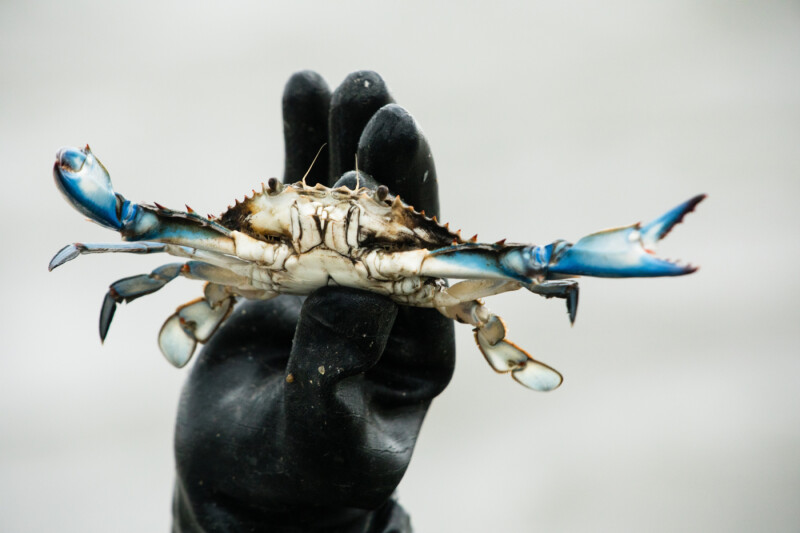
The annual Chesapeake Bay Blue Crab Advisory Report found that adult and juvenile crab numbers are near their lowest recorded levels. The crabs are not overfished, based on biological data – so the clear trend has researchers looking toward other reasons behind low abundance and recruitment.
Those include the availability of crab habitat like marshes and underwater grasses, environmental and water conditions. Predators eating crabs are another factor, with fishermen and researchers alike looking at invasive blue catfish that are reported to becoming endemic in some bay tributaries.
There are crabs for sale in the peak of season, at a price. In mid-July retail prices for blue crabs at Annapolis ranged from $75 to $140 a dozen, NBC News reported.
It’s the prospect of future problems that has advisors cautioning Virginia and Maryland to keep precautionary management measures, as they look forward to a new benchmark stock assessment expected in early 2026.
The annual crab advisory report draws on data from the 2024–25 Winter Dredge Survey conducted by Maryland and Virginia, and its estimates of the blue crab population. The dredge survey results reported in May pegged the overall crab numbers at 238 million in 2025, down from 317 million in 2024 – making it the second-lowest number since the survey began in 1990.
Alongside decreased abundance of adult male and female crabs, the results showed a sixth consecutive year of below average juvenile recruitment found in the survey.
In its followup report issued June 24, the advisory committee reported there were about 108 million mature female crabs at the start of the 2025 crabbing season, above the abundance threshold of 72.5 million females called for in management planning, but below the target of 196 million.
The percentage of female crabs removed by fishing in 2024 was estimated at 22 percent. That “exploitation rate” is below the management target of 28 percent and the threshold of 37 percent.
“Although these results suggest that the blue crab population is not overfished based on the current biological reference points, estimated adult abundance and recruitment remain at or near the lowest levels of their respective time series,” the committee reported.
The advisors recommend “precautionary management measures focused on protecting mature females and juveniles to maintain a healthy spawning stock.”
Management agencies “should also consider conservation-minded measures to protect males given that the conservation trigger for male harvest has been exceeded several times in recent years,” they added.
On the same day of that report the Virginia Marine Resources Commission voted to maintain its blue crab regulations for the coming year, including extending the closure of the state’s winter dredge commercial crabbing seaons.
The federal-state Chesapeake Bay Program issued a summary of the situation at the end of June:
- The overall blue crab population in early 2025 was 238 million. This is down from last year’s 317 million, marking the second-lowest population since the Winter Dredge Survey began in 1990.
- There were 103 million juvenile blue crabs in 2025, a drop from last year’s 138 million and the third-lowest population since 1990. (The lowest and second-lowest populations were observed in 2021, and 2022, respectively.
- The female population was 108 million, a decline from the 133 million in 2024.
- The male population was 26 million, down from 2024’s 46 million and the lowest estimate since 1990.
Overall, the blue crab harvest in 2024 was 42.5 million pounds, down from the longer-term average of 59 million pounds. In 2025, the overwintering mortality of crabs was estimated at 4 percent, higher than in recent years, but still below the 1996–2025 average of 5.98 percent, according to program managers.
Scientists are continuing development of n updated benchmark stock assessment of blue crab population dynamics, to update the last benchmark released in 2011.
“We are looking forward to seeing the results of the current blue crab benchmark stock assessment to see if it can provide insight into the changing dynamics in the Bay, given that overharvest does not appear to be the primary reason for the continued low abundances documented in recent dredge surveys,” said Maryland’s blue crab program manager Mandy Bromilow.