

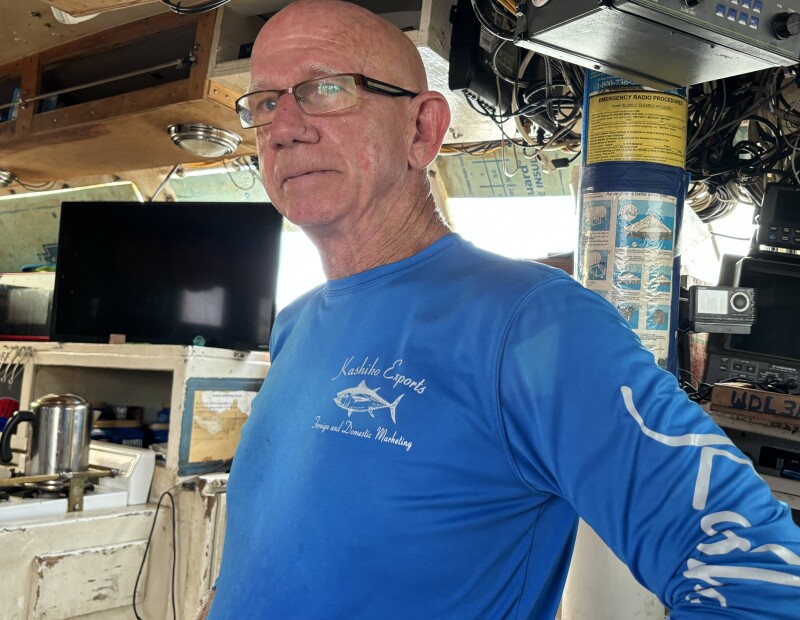
For Marty Scanlon, president of the Blue Water Fishermen’s Association (BWFA), tuna fishing is a passion as much as a business. Since 1991, he has been running his 43-foot vessel, the Provider II, out of Long Island. But the business is getting rough.
By the time he gets into the Willie Etheridge Seafood dock in Wanchese, N.C., in August 2025, just ahead of Hurricane Erin, he and his crew are at their limit. A problem with the longline reel has forced them to haul back fifteen miles of gear by hand, and not for a lot of fish.
“It took us two days to get the gear back,” says Scanlon, pointing to a pile of monofilament in a big fish box. “And it only took us a half an hour to unload.”
According to Scanlon, the number of East Coast U.S. tuna fishermen has dropped precipitously from 438 to 68 over the course of his career. The remaining fishermen have faced numerous challenges, among them cheap imports and uncertain and ambiguous regulations.
“Normally we’re not down this far this time of year,” says Scanlon. “We were hoping the monuments were going to be open up there, but that’s not going to happen this year. It needed to happen in June; now there’s only a month left of good fishing there before the weather gets bad.” Scanlon is referring to the 5,000 square mile Northeast Canyons and Seamounts Monument that was closed to commercial fishing under President Obama in 2016, reopened by President Trump in 2020, and closed again under President Biden.
In April 2025, a new executive order from Trump directed the councils to roll back onerous regulations and reopen the monument, but that process is ongoing. “Maybe next year.”
Scanlon is also hoping to see the Charleston Bump Closed Area Fishery Management Area reopened for pelagic longlining. “The BWFA is working on it,” he says. “Amendment 15, Spatial Management.”
While scientific reports from the International Commission for the Conservation of Atlantic Tunas (ICCAT) indicate a precipitous drop in the biomasses of almost all Atlantic tunas since the 1950s, bluefin are rebounding, and the yellowfin, bigeye, and skipjack that Scanlon targets are beginning to climb or holding steady.
While Scanlon reports having a decent winter, he notes that he had to fish out to the edge of the continental shelf to find yellowfin and swordfish. But he is not surprised that the number of East Coast tuna fishermen continues to decline.
“I mean, look, you don’t know what they [the regulators] are going to do next,” he says, recalling years of arbitrary regulations. “They tell us things like that if a whale gets a hook in it, the whale has a 50 percent chance of dying.”
The Provider II is equipped with electronic monitoring cameras that record continuously when the boat is fishing. “Originally, they told us they were for monitoring the bluefin ITQs, but in reality, they are building a database on all these boats.”
Scanlon isn’t surprised that new fishermen aren’t coming into the fishery. “Why would they?” he asks, noting that besides regulations, the U.S. is importing tons of low-priced tuna. “Who’s going to invest if you don’t know when they’re going to put you out of business?”
But Scanlon in his role with the BWFA wants to change that. “I work with all these people, Oceana (an environmental group), all of them. I want to understand where the disconnect is. I engage with everybody to try and solve our problems.”