

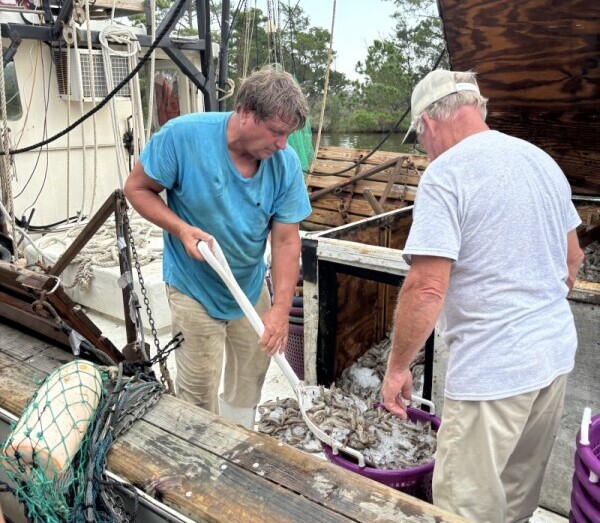
On the Outer Banks, everybody’s cell phones are buzzing with mandatory evacuation orders, but Hurricane Erin has turned northeast, and not a lot of people are on the move. In Pamlico Sound, it’s business as usual as Gregory Brooks steers his 40-foot shrimp boat, the Rebait, alongside the dock at Newman’s Seafood in Swan Quarter, North Carolina.
He’s got a nice load of mixed shrimp aboard, brown and white, or green tail as they’re called. “Right now, the season’s changing,” Brooks says. “From the brown to the white.” He and his uncle, Tommy Brooks, have been out for less than 24 hours and they’ve landed more than 30 baskets.
“They had 2,200 pounds,” says Michelle Newman, manager of Newman’s Seafood. “That’s not bad for the time they were out.” According to Newman, her family’s packing house has about five or six boats that come in every week. There are about 15 packing houses here in Hyde County,” she says. “Others have more boats. Only the smaller ones can get up in here.”
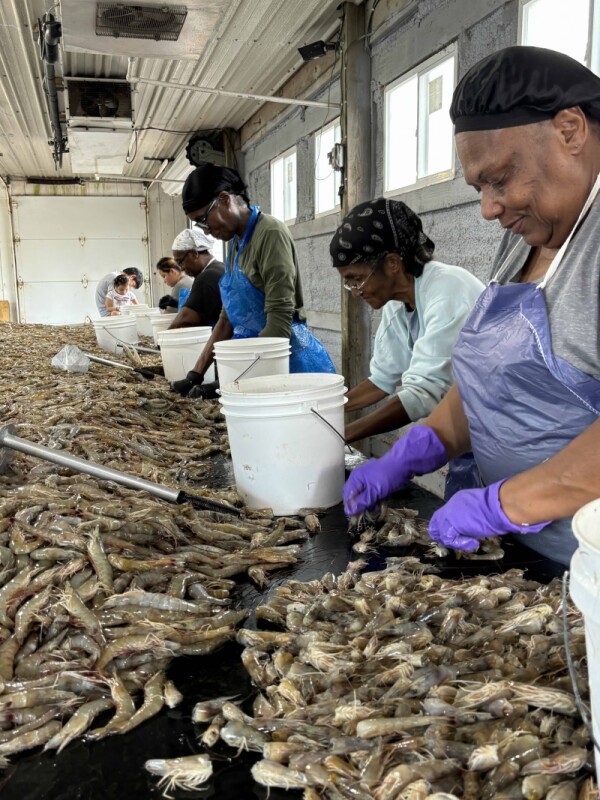
When a boat comes into Newmans, the crew comes down from the village of Swan Quarter to snap the heads off the shrimp. “It’s money for them to buy school clothes for their kids and things,” says Newman.
She recalls how a proposed ban on shrimp trawling was tabled in the state legislature in late June.
“We took a bus up there to fight it,” she says of Bill 442, which would have ended shrimp trawling in the state’s internal and nearshore water. “Shrimping is one of the only things for people to do around here. It would have killed this county.” But she notes that the battle is not over. “They’ll try again,” she says.
Many blamed the Coastal Conservation Association (CCA) for promoting the bill, but according to David Sneed, executive director of the North Carolina chapter of the CCA, he found out about it the same time as the fishermen.
“It’s back in comittee now,” he says. “We supported it, but a complete ban is really too much. We would rather work with the industry and find a compromise. We know where the nursery areas are. We want to protect those. We don’t need to close all the sounds.” Sneed notes that while he would like to see a compromise, there is very little dialogue between the CCA and commercial fishermen these days.
According to a story by Todd Wetherington in the Carteret County News and Times, a new fisheries organization, the North Carolina Coastal Counties Fisheries Coalition (CCFC), has been formed in response to the proposed trawl ban. The coalition’s stated mission is to educate legislators.
chairman Bob Woodard is quoted as saying: “We want to eat local shrimp, and we want to eat it out of clean waters. Nothing’s more important than protecting the livelihoods of our commercial fishermen.”
Worthington reports that at the CCFC’s second meeting on September 16, Brent Fulcher, chairman of the North Carolina Fisheries Association said that North Carolina was leading the country in bycatch reduction. He suggested that fishermen should convince the Legislature to reform the currently inactive Joint Legislative Commission on Seafood and Aquaculture.
“That way it puts fishermen, recreational users, and legislators on the same page and we can educate them, and we can come to workable solutions,” Fulcher is quoted as saying.
For the people in Swan Quarter and other communities around the sounds, shrimping is vital. In the fight for their way of life, educating legislators and finding workable solutions is the only way forward.