

For decades, trawlers and purse seiners have relied on Marport wireless net sensors to see what their gear is doing and what it’s catching, and the France-based company has continually striven to improve the performance of its products. The latest upgrade is the Pro NX series that Marport is advertising as its Next-Gen sensors.
“We started shipping them in the summer of 2025,” says Craig Cushman, director of marketing at Airmar and Marport, which are both owned by Connecticut-based company, Amphenol, one of the world’s largest providers of sensors and related technologies.
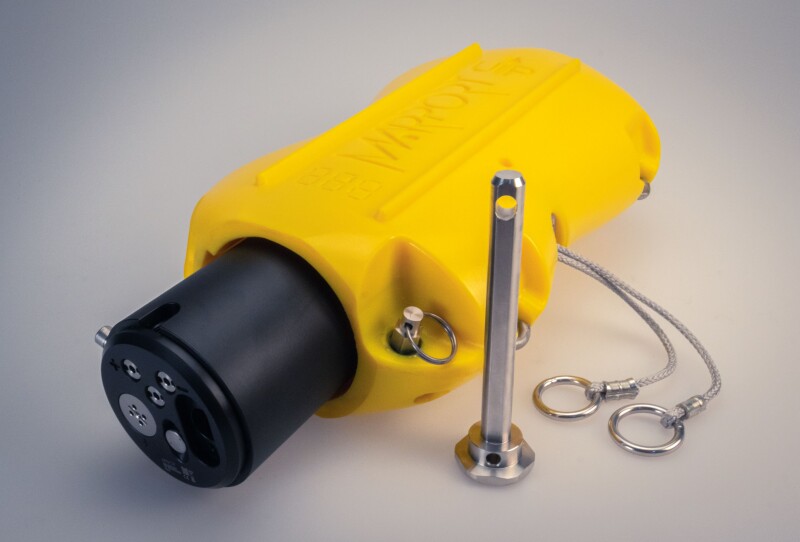
“The NX series or next-gen series is the latest evolution of the sensors. With many new features, the sensors deliver excellent performance and efficiency. An example is the Catch sensors, which are attached to the net. It used to be that to charge, you might need to remove the whole sensor and housing from the net and take them to the charging station.
Cushman observes that this was neither the most user-friendly nor the most efficient system. “With the Pro NX Catch series, the housing stays on the net, and only the sensor is removed and brought to the charging station. A newly charged sensor quickly slides into the housing, so the boat keeps fishing. And while the instrument is charging, it’s also easily updated and configured to be ready for the next use”.
The sensors can also be programmed for use at multiple locations on the trawl, and, according to Cushman, they are interchangeable and can be programmed to work with most NX housings on the net. “Usually, a trawl will have sensors on the doors to provide that spread and height data, one on the headrope to measure its height and monitor fish entering the net,” he says. “There are usually catch sensors in the middle of the net and another on the codend to monitor catch amounts. That’s five in all, but captains can scale up the number of sensors to receive as much data as they want.
Marport has as much as doubled the battery capacity on the new line of sensors so that the instruments do not need to be charged frequently. “They can last for up to 46 days,” says Cushman. Marport sales material says the port door spread sensor battery can last 5–8 days, and the starboard up to 12 days per charge—the duration of many fishing trips—and they take 3.5 hours to recharge.
Different sensors transmit acoustic data, and some, like the headrope sensor and codend sensor, are available in an Explorer version and a higher-resolution Navigator version that can provide echo-sounding imagery. “With Catch Explorer, they can see the fish going in,” says Cushman.
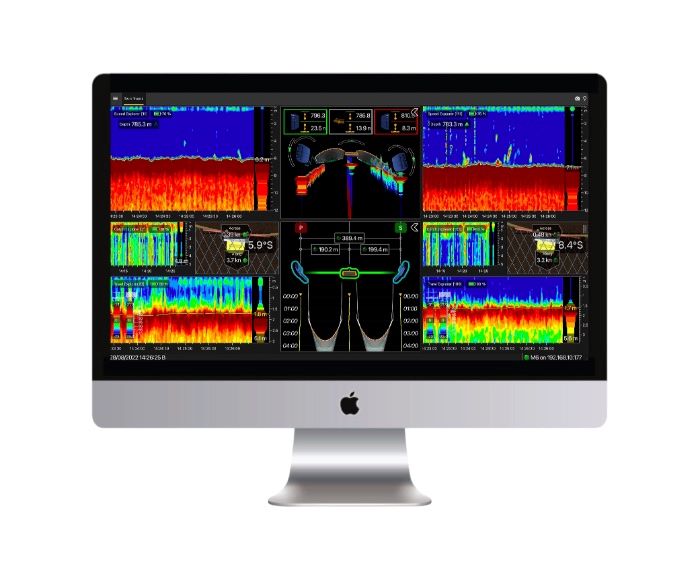
All the sensors transmit acoustically to a hydrophone on the vessel. “The data gets fed into our Scala 2 software and onto a helm display so the captain can see what’s happening,” says Cushman. “Scala software can be customized, but usually shows visualizations of the doors and data from all locations on the trawl net, as well as images of fish coming into the net and the codend.
“There’s more,” says Cushman. “You can see a lot on our website, and there are videos on YouTube.” The upgrades of the Pro NX series have also gone into the purse seine sensors and are making life easier for deckhands and captains alike.