




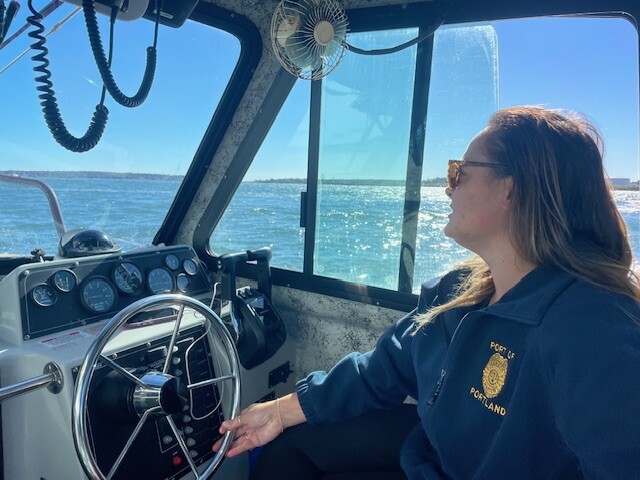
If a movie were ever made about Hattie Train, the ocean would demand co-star billing. That’s because saltwater runs through the storyline of her life, and now, it’s central to her career.
On a sunny yet chilly October morning in Portland, Maine, Train was contemplating the weather, wind, and conditions. She pushed back her departure from shore by a few hours, because of high winds in the Portland Harbor.
Train is the Senior Deputy Harbor Master for Portland, a position she’s held since April 2025. She was hired as one of the deputy harbor masters in June 2024, and also did some work onshore in the office, before transitioning to her current role.
Eye on the harbor
These days, Train is likely to start her mornings untying The Whaler, a 25-foot modified Boston Whaler, that serves as one of the Harbor Master fleet’s workhorses. The department operates a few vessels, the newest being a custom-built boat from Lyman-Morse in Thomaston, Maine, that arrived in October. Built to withstand the Harbor’s high traffic demands, the new boat is expected to be a valuable asset. Train and her colleagues use their vessels to patrol Portland Harbor, one of New England’s busiest working coastlines.
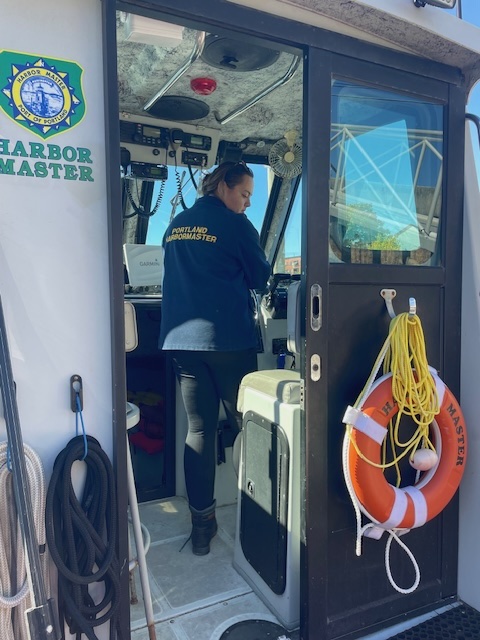
The area Train and her colleagues are charged with keeping safe has deep history; important for shipping, fishing, commerce, travel, and tourism. Today, it's a complex intersection of public and private piers and docks, recreational boaters, cruise ships, ferries, oil and industrial vessels. All are the Harbor Master’s responsibility help to manage, monitor, and protect.
The territory lies between the cities of Portland and South Portland in Casco Bay on the southeast coast of Maine, about 50 miles northeast of the Maine-New Hampshire border. Locals call it “the working waterfront,” and it’s a big part of what gives Portland its character. It’s also a place where Train feels deeply connected.
“I try to get out on the water every single day, especially in the morning,” she says. “It’s the best way to start the day and keep an eye on what’s going on.” Having that “eye on the harbor” often puts her in close contact with the multitude of people who make their living here. On a recent morning patrol, she waved to commercial fisherman Captain Pete Speeches, a familiar face who, alongside his daughter Erin, appeared on a season of National Geographic’s “Wicked Tuna.”
But not every sighting on the Harbor is routine. “There is a cute male seal who likes to hang out near the Maine State Pier. I saw him rolling around on his back, with his dick in the air, pointing at a cruise ship,” she laughs. “You see it all out here!” Marine life is a side perk of the job. Train has spotted pods of porpoises and, on one lucky day, a Minke whale, one of the more elusive visitors to the Gulf of Maine during summer feeding season. “They’re fast and shy, so it was neat,” she says.
Celebrity sightings have not been as common for Train. But according to the dockside chatter, a yacht rumored to belong to filmmaker Steven Spielberg was anchored in the harbor. It wouldn’t be surprising after all, this working waterfront has always attracted a cast of colorful and competent characters, and Hattie Train is among them.
While there is levity and joy in the work, Train and the other Harbor Masters are responsible for overseeing moorings, safe navigation, and operations within the waters of the Harbor. Everything from vessel access rights and coastal zone management conflicts to monitoring marine construction projects and the safe and orderly movement of vessels falls under their purview. The harbor masters are managed by the Harbor Commission, five representatives tasked with regulating navigation and commerce within Portland Harbor. There is one Harbor Master and five deputy harbor masters including Train.
If there is such a thing as a “typical” day for Train, it starts early. She’s usually up by 6 a.m., and before coffee or breakfast, she’s checking the Automatic Identification System app on her phone and monitoring vessel traffic in Portland Harbor to make sure everything looks as it should.
“I look for boats that don’t make sense,” she says. “Or boats that don’t make sense in a location. You get used to the rhythm. You get used to the dance.”
From there, she checks her email and connects with other agencies, especially the Portland Pilots, who play a critical role in safely guiding ships in and out of the busy port. Then she heads to the waterfront office, climbs aboard one of the Harbor Master vessels, and begins her daily rounds.
Train prefers to be back onshore by lunchtime, when she shifts into a different gear: office work. This includes reviewing mooring or construction permits, patrolling the coastline by truck with a colleague, or preparing for upcoming meetings. It's a balance of on-the-water operations and behind-the-scenes logistics.
“I work as long as I need to get things done,” she says. One recent evening, that meant staying up late to complete a grant proposal for a new dock at 2 Portland Fish Pier, in the heart of the city’s working waterfront. The grant was awarded, a big win for the harbor masters.
But no matter how organized the day looks on paper, unpredictability is woven into her job.
“Emergencies happen.” Just the previous week, a boat sank in the harbor. As Train made her way to the waterfront, she coordinated response efforts en route. “By the time I got to the dock, everything was already activated,” she says. “People and agencies were in place.”
No matter the task or the weather, safety remains the constant. “We prioritize not becoming someone who needs to be rescued,” she adds.
Rhythms of the harbor: An “intricate dance” of users
From her daily patrols, Train has gained a deep understanding of the scale of the harbor’s operations. “Anyone who spends even a day on the water can see how connected Portland Harbor is to a global network,” she says. As she patrols, she points out the container ships making use of the deep-water port, oil tankers and fuel storage, commercial fishing vessels, research vessels and institutions, seafood exports, ferries to island communities (with year-round and summer residents), tourists, and cruise ships.
She has also learned the rhythms of this working waterfront. “It’s really beautiful to watch the intricate dance,” smiles Train. “because that’s what it is. A dance of different users and types of traffic. And when it flows smoothly, that is good.”
That “dance” plays out regularly beneath one of her favorite sights: the Casco Bay Bridge, a 4,748-foot bascule structure with 65 feet of clearance, that spans the Fore River between Portland and South Portland. “No matter how many times I’ve seen it, watching the bridge rise and lower is always fascinating.” Seeing ship traffic pass through below while cars, buses, cyclists, and pedestrians move above is a thrill.
In many ways, Train seems as if she were always meant for this role. “They know this vessel, and know the Harbor Masters, and they know me. I’m a 28-year-old who has been at it for 20 years,” she laughs.
Deep connections
Long before she metabolized her experiences growing up here into a career, Train was involved with the Harbor and ocean. She was 8 years old when she got a lobster license. Her dad, Steve Train, is a veteran lobsterman and fisherman who lives on Long Island, in Casco Bay. Her mom, Marci Train, teaches science at the school on Long Island where Hattie was raised and where her parents still live.
Growing up, Hattie worked stern on her father and grandfather's lobster boats, was a deckhand on Casco Bay Lines ferry system. She became a rescue swimmer on Long Island when she was in her teens. For a few years, she had her own fisheries consulting business.
She credits her parents for giving her the foundation she has, that she carries with her in her work today. “My parents never talked down to me. My Dad made sure I understood policy and politics. And my mom is a science educator [and] the elementary school kids she teaches get to do research and studies at a collegiate level!” says Train.
In college, Train studied Marine Science at the University of Maine Orono and earned a B.S., with a focus on fisheries and aquaculture. She’s competed in the Peaks to Portland swim, one of the oldest open water swims in the world, where thousands swim the 2.4 miles from Peaks Island to Portland’s East End Beach, in chilly and often difficult conditions.
She also had a three-year stint where she lived on a boat in Portland. Ironically, she got kicked out for swimming in the Harbor during an extreme high tide and flooding event, after a video her Dad Steve posted went viral on social media in the winter of 2024. “This harbor and I are so entwined,” she says.
Her love of the ocean is woven into her identity and Harbor Master career, but so are the deep connections and relationships she’s built. This is where her long history of growing up on Long Island, working jobs in the area, and “having a history here” is her superpower. But, she acknowledges, “Trust is earned in the Harbor.”
Being out every day and seeing people and “being the eyes on things” is balanced with more behind the scenes desk work that includes reviewing policies, understanding licensing changes, and permits. Train says knowing how to communicate with various users on the water is critical to her work.
Women in charge
During a recent patrol, Train passes a red tugboat with white railings, the Nancy McAlister. “Nancy is really cute, I love tugboats!” As she passes a cruise ship, passengers wave at her from the top deck. She returns the favor, and moves on.
Train says Harbor Master roles are often filled by people later in their careers, sometimes even post-retirement. It’s not a path most people, especially women, start young. This makes Train an exception, at 28. That said, she’s not entirely alone.
A growing number of women are making their presence known in Portland Maine’s maritime community. Among them are the head of Port Authority, head of Port Security, one captain of a tugboat, and a woman who works on a fireboat. Train communicates with them regularly, and finds strength in their presence, even if the list is still short.
A changing harbor
Growing up here and her work on the water has given her a front row seat to changes that shape the Harbor, and cities around it. She points to gentrification in Portland, which impacts the harbor and operations on it. This is where her background in marine science helps her understand all of the interests at play, and how they might all work together. “Looking at the Harbor, I’ve already seen change in my lifetime, and I will continue to see change.” She takes it in stride and sees the long view.
Train approaches her work with the attitude that there’s always more to learn, and she continues to take classes, like search and rescue.
“I know what can go wrong. My greatest fear is drowning. So I have a fear and a respect for the ocean. But it's a healthy respect, because the ocean is beautiful. It’s also wild and can be violent – and when she’s angry you need to respect her.” But she also adds “I know this Harbor and this bay, and the way the current works.” She adds, “I function best under pressure.”
On a deeper or even spiritual level, she says being on the water offers something land does not: “It clears my head.”
Appreciation for workers
From her perspective, there is a lot to be grateful for in her position. “I have an appreciation for those who love the water, and the Harbor.” But I also have such an appreciation for the work others do, how hard they work, and the conditions they have to work in out here. From tug boats, to commercial fishermen, to pilots, to many others whose work centers on the Harbor.”
It is all about utilizing the networks she has cultivated over the years, and weaving that into her position. She knows “who to call, and to keep building upon relationships I have grown up with around this Harbor.” She values opportunities to educate the public–events like Walk the Working Waterfront which invites the public to explore Portland’s working piers and wharves, tour vessels, and chat with fishermen and those making a living on the water.
While on her routine rounds visiting all public docks and checking things out, she still finds moments to take photos. Recently, she slowed the The Whaler near Cape Elizabeth and Portland Head Light, a historic lighthouse that sits at the entrance of the primary shipping channel into Portland Harbor. It is the oldest lighthouse in Maine. Train smiles and snaps a quick picture. “I never get tired of lighthouses!”
 (1).jpg.small.400x400.jpg)
