California Fish and Wildlife’s Risk Assessment and Mitigation Program (RAMP) is working to reduce marine mammal entanglements and is allowing fishermen willing to use ropeless gear a chance to keep fishing in areas where whales congregate after April 1.
Getting fishermen to try new things, particularly very expensive things, has never been easy, but the National Marine Sanctuary Foundation has been making strides in convincing Dungeness crab fishermen to try pop-up gear through its Innovative Gear Lending Library. “We’ve been working with fishermen experimenting with different systems since 2021, but most testing didn’t really get going until we were issued an EFP in 2023.” says gear innovations manager, Greg Wells. “We started with a grant from the California government’s Ocean Protection Council that allowed us to buy some of these systems,” says Wells. “Our job has been to support testing while reducing the financial burden on fishermen and gathering data and feedback.”
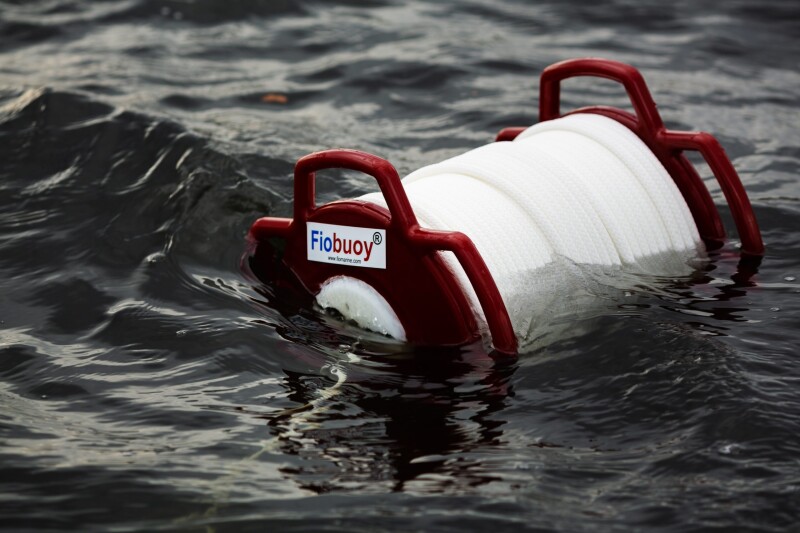
Modeled after similar programs in New England and Canada, the NMSF library has a collection of on-demand gear from seven different manufacturers. The range includes three different types of acoustic release pop-up buoys, including the Desert Star Systems ARC-1XD, EdgeTech 5112, and the Sub Sea Sonics AR4RT/Guardian Sled. “We also have an acoustic release buoyant spool,” says Wells. “That’s the Fiomarine Fiobuoy. When the acoustic release is activated, a spool of line unwinds and comes to the surface. We also have the inflatable lift bag from SMELTS called a Lift-Raft.”
All of these systems work by sending an acoustic release signal from the vessel, which triggers the device on the seafloor to release buoys or inflate a lift bag. Once the buoys or bags rise to the surface fishermen retrieve them and haul the traps. Another simpler system that Wells is working with is Guardian Ropeless Systems’ galvanic timed release (GTR) buoy system, in which a galvanized metal clip disintegrates over a set period of time, releasing the submerged buoys around the time that fishermen expect to be there to haul their gear.
Wells reports that fishermen’s feedback has led to changes in the gear. “We had one guy who did about 150 trials with one of the acoustic systems, and he had a lot to say about the deck unit and control software, which contributed to the manufacturer’s revamp of the system.” Wells notes that most fishermen have only used one type of gear. “It’s hard to make direct comparisons but fishermen have share preferences. One thing we’re hearing is that Dungeness fishermen would like to see systems that fit better with their round traps. Most of these were developed for the lobster fishery in the east, and they’re boxy, to fit with the lobster traps.”
The cost of the gear has forced Dungeness crab fishermen to switch from fishing single traps to fishing trawls. “They call them strings here,” says Wells. “Some fishermen started off with a smaller number of traps per string. And for some it’s been a learning curve with a bit of trial and error. Our EFP allows up to 50 traps per string, but most are fishing around 20.
As fishermen get used to the on-demand systems losses are minimal. “We had 93 percent success last year,” says Wells. “When fishermen had pop-up buoys on both ends, it was 96 percent, and I think we got every trap back last year. We didn’t have any losses of gear or equipment.”