

Flux Marine, in Bristol, R.I., has spent the last 10 years developing a line of electric outboards for work and pleasure boats, and recently launched its latest innovation, a 115-hp electric outboard.
“Its acceleration is similar to a 175-hp gas outboard,” says Annie Venditti, associate director of partnerships and marketing at Flux, noting the immediate full torque associated with electric motors.
Flux is currently promoting its partnership with rigid inflatable maker, Highfield Boats, equipping its 24-foot model with the Flux 115. “Our customers are impressed that we can put this package together for $120 thousand,” says Venditti, noting that the 115 also works well on garvey-type work boats.
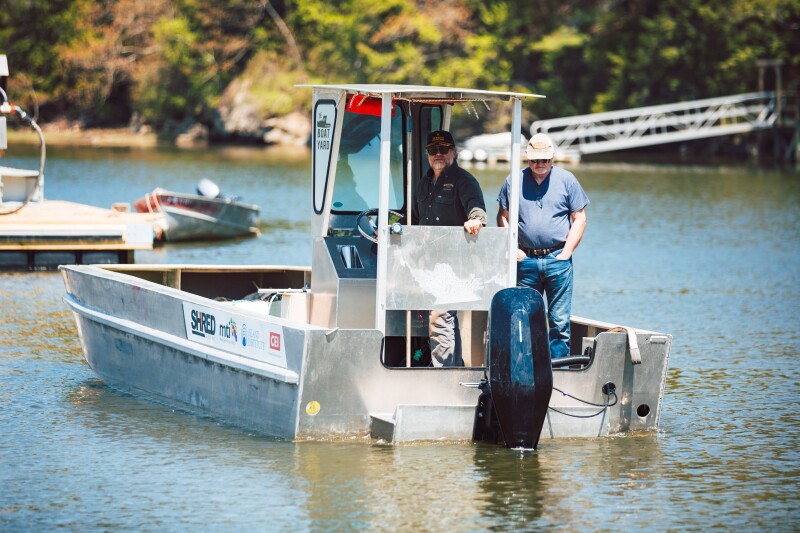
“We have one being used in a boatyard, moving material around,” says Venditti. “And others in aquaculture, where the boats are puttering around oyster farms and can be charged overnight.”
According to Venditti, the motors have a range of 80 to 100 miles on a full charge when operating at around 5 miles per hour. “Up on plane, about 20 to 24 miles per hour, they have a range of 30 to 40 miles,” she says. “This summer one of our customers ran his Highfield 660 from his dock in Bristol all the way to Block Island. We love it when people do things like that to show how far you can go in an electric boat.”
The Flux system uses three batteries measuring 32"x17"x12" and weighing 350 pounds each. Cumulatively, the batteries deliver 84 kWh. Venditti notes that because they are modular, the batteries can be integrated into the hull design.
“Our battery management system is built in-house,” says Venditti. “And because of our dynamic software, the operator can look at their Garmin screen to get real time data and the most efficient speed to run their boat. ” She adds that Flux also receives data from its motors. “We get a data input transmission every 10 to 15 seconds,” she says.
“The Flux motor is also modular in its design,” says Venditti. “The top section we call the power head. It includes the charger, the inverter, and the motor controller. The middle section holds the electric motor, and the lower unit is the belt housing and the propeller.” The Flux lower unit is open, allowing better water flow to the propeller than standard gas and diesel outboards.
\Flux guarantees its electric propulsion system for five years, and according to Venditti. While the initial purchase price of a Flux-powered boat is typically higher than a comparable gas-powered model, owners save significantly on fuel and maintenance over time.
“You’re paying a small premium up front,” she says. “But you eliminate many of the pain points of gas boating—there’s no fuel cost, far less maintenance, and you get high performance with whisper-quiet operation.”