

Almost everyone who has spent time on the water has heard a thump while running at night—the sound of a log, a barrel, or any UFO, bouncing off the bow—and gone below to check for leaks. Fewer have had to deal with the horror of a man overboard at night. But Teledyne has the technology to reduce the hazards of night running and to help find someone in the water in the event of an MOB.
“Safety; that’s the number one reason people are buying our cameras,” says Eric D’Ancicco, regional sales manager for FLIR. “If it’s going to increase my chance of survival by even 20 percent, I want it. With the FLIR camera, you can see in complete darkness. So, if somebody falls overboard in the Bering Sea, you can spot him even if you can’t see him with the naked eye. It’s about saving lives at sea. If it’s going to increase my chance of survival by even 20 percent, I want it.”
According to D’Ancicco, the FLIR camera can also help mariners spot objects floating on the surface, everything from logs to buoys. “Our camera can pick up a temperature difference of a small fraction of a degree, so even if that log is cold, it’s not as cold as the water, and you can see it. I do a demonstration at shows where I take a book and slap it with my hand, and then point the camera at it. You can see the impression of my hand as much as 25 pages into the book. Another thing we found was that during the Deepwater Horizon oil spill, FLIR could see the oil on the surface at night, which meant cleanup could go on 24/7.”
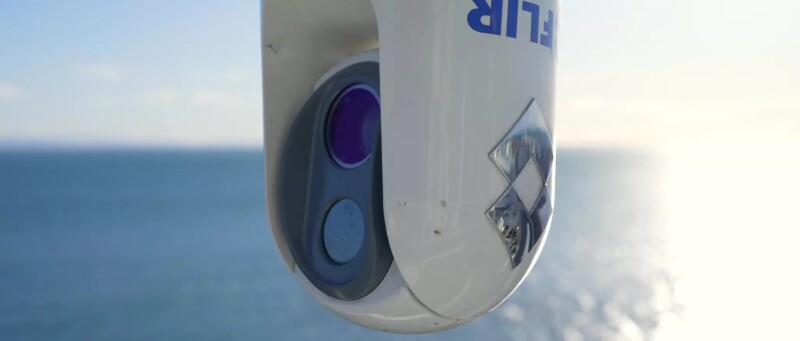
While Teledyne sells the FLIR camera systems to a wide variety of clients, including the military, merchant vessels, and yacht owners, D’Ancicco believes that, besides safety and collision avoidance, fishermen can benefit from the overall situational awareness that FLIR provides. “FLIR stands for Forward Looking Infra-Red,” he says. “And the images the camera captures can be displayed on any MFD. You know the infrared images you see of police chasing somebody at night? That’s the kind of images you see.” In a crowded fishing area, D’Ancicco notes, FLIR users can have a better idea of what nearby boats are doing.
D’Ancicco adds that the range of the FLIR cameras varies by model. “With the M232, our base model, it’s about a mile, but with the M500, our top of the line military grade model, it’s 5 miles.” Prices start at $3,000, and D’Ancicco notes that he sold three systems at the 2025 Pacific Marine Expo. “I didn’t get a lot of feedback on how fishermen are using them other than safety and collision avoidance,” he says. “But I can tell you if I go up to Ballard, here in Seattle, I see them on a lot of boats.”
D'Ancicco also notes that installation is very simple. “It’s just a plastic base and four bolts. There are two wires to connect to your MFD, and the camera itself can rotate 360 degrees.” For fishermen who want the safety and security of being able to see in the dark, Teledyne is offering the FLIR solution.