The move toward on-demand lobster and crab gear to protect whales from entanglements has been slow and steady, facing resistance from fishermen concerned about the cost and feasibility of untested technology. Massachusetts-based EdgeTech is among the many companies developing on-demand buoys that will stay on bottom with lobster and crab traps until fishermen acoustically release them in order to haul their gear.
EdgeTech’s product line manager, Rob Morris, notes that lobster fishermen on the east coast have been pushed hard to adopt on-demand buoys in order to protect the endangered North Atlantic right whales, but in California, Dungeness crab fishermen have also had humpback and gray whales get entangled in their gear, and steps are being taken to reduce vertical lines in the water at certain times of the year.
“We started working with the National Marine Sanctuary Foundation about 5 years ago,” says Morris. “They have a gear lending library that lets qualified fishermen experiment with different types of on-demand gear. Last year, California Fish and Wildlife let some fishermen fish with EFPs (experimental fishing permits), and after that, they decided to approve certain types of on-demand gear for use in the fishery, so we applied in September 2025 and were approved in early January of 2026.”
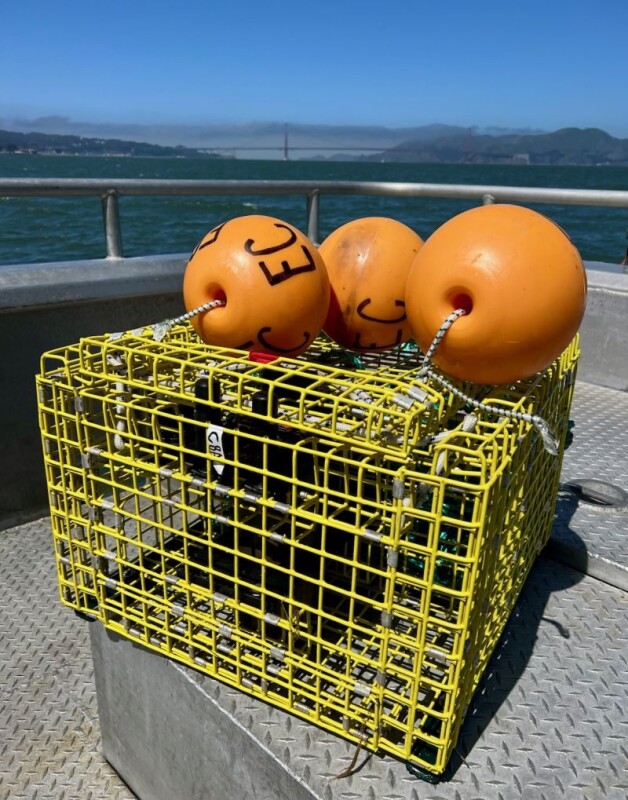
The Edge Tech system is comprised of several components, the most important of which is its release mechanism, an 18-volt unit that runs on eight 9-volt batteries that generally last a year. Sufficient buoy line is coiled into a cage, then a lid with several round buoys is fitted on top and attached to the release mechanism. On board the vessel, operators can use a hull mounted transducer or one that is held over the side. “Obviously, the hull mounted is more efficient,” says Morris. “Because you don’t have to stop the boat to get a good signal. And it’s safer, because you don’t have someone hanging over the side.” Controlled by a portable or consol mounted deck unit, an acoustic signal is sent to the release mechanism that then releases the lid, which floats to the surface. “The cage can also talk to you,” says Morris. “It can tell you if it’s tilted, or if the battery is low, and it reports temperature on the bottom.” According to Morris, the EdgeTech fail rate is less than 10 percent, which is close to California Fish and Wildlife’s most generous estimates of gear loss in general. “But with EdgeTech you can still find the gear and grapple it,” he says, noting that crab fisherman Dick Ogg used the Trap Tracker app to grapple all his traps, eliminating the cost of the entire EdgeTech system.
“Now that our EdgeTech system is approved, fishermen can use our gear to fish in California’s restricted areas after April 1,” says Morris.
One sticky point is that Dungeness crab fishermen generally fish single traps with a buoy, meaning lots of rope in the water and an unreasonable cost if they need to put a $4,000 EdgeTech system on each trap. “They will have to trawl up,” says Morris, meaning they will have to put a number of traps on a groundline and put on-demand buoys on one or both ends. “The cost becomes manageable if you look at a system lasting 15 to 20 years on a 40-trap trawl.”
Morris notes that many fishermen have raised concerns about setting over each other’s gear when no buoys are showing. “But with our Trap Tracker app, you can see where all the other gear is, as long as you have an internet connection. And the marks are also on another app from Earth Ranger, the ER Buoy app, which shows where all our traps are.”