Researchers studying fall-run Chinook salmon headed to California's Central Valley rivers are monitoring their migration, hoping to identify factors from water temperature to nutrition that help get them to the spawning grounds.
"We have been tagging salmon yearly since 2022 for this project," said Miles Daniels, an associate researcher at the University of California, Santa Cruz, who is also an affiliate of the National Oceanic and Atmospheric Administration's Southwest Fisheries Science Center. The research is funded by California's State Water Board, which is interested in whether water can be managed to benefit the salmon while still supplying farms in the state's Central Valley with irrigation water.
That water is important to the growth of billions of dollars' worth of produce and other agricultural products. It is also the highway for Chinook salmon migrating under the Golden Gate Bridge in San Francisco into the upper Sacramento River, and through the Sacramento -San Joaquin River Delta to the Central Valley Rivers' spawning grounds.
"Our long-term focus is to keep working toward a better understanding of what factors (individual, environmental, or other) are related to fish successfully making it to their spawning grounds," said Daniels.
One big question is whether the salmon are burning too much energy, and what factors affect this. Researchers are studying salmon at a research lab adjacent to UC-Santa Cruz, salmon that need cold water and may stop migrating if they reach water that is too warm. Such delays could deplete their energy needed for migration and spawning, since they do not eat on the way back upriver.
They are also tagging some fall-run Chinook salmon and tracking their migration.
"One of the behavioral patterns we are seeing is that fish that move through the Sacramento-San Joaquin Delta faster tend to have a better chance of making it to rivers and spawning grounds," Daniels said. "This makes sense since the Delta is potentially a more stressful area for fish, but it's interesting why some fish are able to navigate it quickly while others seem to get lost. In regard to food, our study is really focused on the freshwater component of migration, and so we think most of these fish are fasting and largely not eating as they make their way to their natal streams. Our lab has been doing other research on food-web dynamics in the ocean as they relate to the stressor of thiamine-deficiency, which is outlined in this recent attached publication."
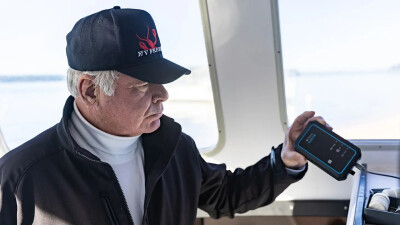
Since starting the project in 2022, the research team has been working with Johnny Atkinson, a veteran charter boat captain who runs New Rayann Sportfishing in Sausalito, to tag Chinooks in order to track their migration and find out who makes it to the spawning grounds. California waters have been closed to most salmon fishing for the last three years, but the tagging project gives avid anglers a chance to catch salmon for a good cause.
" They get to fish, and that helps us all better understand what these fish are facing and how we can give them a better chance to survive,” Atkinson said. In return for catching the fish, participating anglers get tracking numbers for their catch so they can follow the fish online as they migrate.
The tagging process itself has improved fromthe use of internal tags that had to be surgically implanted in the fish to external tags that biologists can attach quickly.
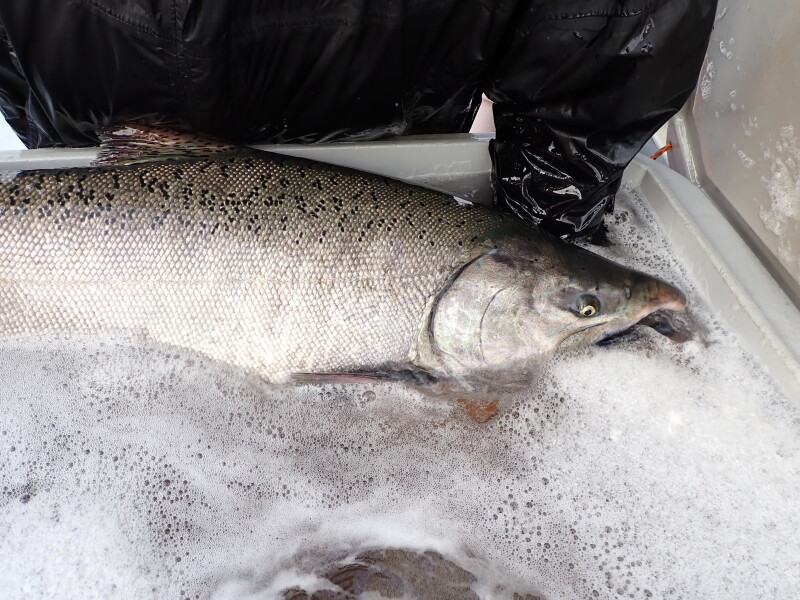
And it's so much faster. "On average, the fish are only on board now for about five minutes before they're safely released back into the ocean, Daniels said. The external tags are much faster and also part of the effort to ensure that the research project has as little impact on the fish as possible, he said.
So far, the monitoring stations have detected over 50 fish moving through the Sacramento-San Joaquin Delta. The Delta itself is a maze of canals and river channels where huge pumps move water to important agricultural lands to the south. Researchers describe the area as possibly one of the most perilous parts of the migration route for California salmon, both to the ocean as juveniles and back to the ocean as juveniles and back to their spawning grounds as adults.
Although most fall Chinooks in the Central Valley come from hatcheries, many spawn naturally in the upper Sacramento and San Joaquin rivers and their tributaries, researchers said. A few tagged salmon have been detected near their spawning grounds over 200 miles upriver from the Golden Gate Bridge.
Daniels said that initially it appears that salmon with a high fat content may be more likely to make it through the Delta to the upper Sacramento River, but new studies note that California salmon are returning to their rivers deficient in thiamine. Rachel Johnson, a research scientist with the Southwest Fisheries Science Center, notes that thiamine plays an important role in metabolic and bioenergetic capabilities in salmon, so fish deficient in thiamine may have an even harder time in warmer waters.
When salmon eat anchovies, the anchovies' digestive enzyme, thiaminase, breaks down essential thiamine in the salmon's gut, leading to a deficiency that weakens adults and causes high mortality in their offspring.
Johnson has worked with Atkinson and the anglers to learn what they are seeing in the changing ocean to learn more about how salmon diets can cause thiamine deficiency.
Daniels and his team, meanwhile, are working on the analysis of their research to date to be published in a peer-reviewed scientific journal.
"Anecdotally, we are seeing that a lower proportion of fish that were tagged and tracked in 2022 successfully made it to rivers compared to 2023," Daniels said.
"Environmental conditions in the marine and freshwater were generally poorer in 2022, with a large-scale harmful-algal-bloom (HAB) occurring in the San Francisco Bay in 2022 which was linked to drops in dissolved oxygen and observed fish kills.
"We think there were likely other negative effects that occurred in 2022 linked to drought conditions. The bright side is that some fish survived and made it to their rivers in 2022, which shows how resilient these fish can be."