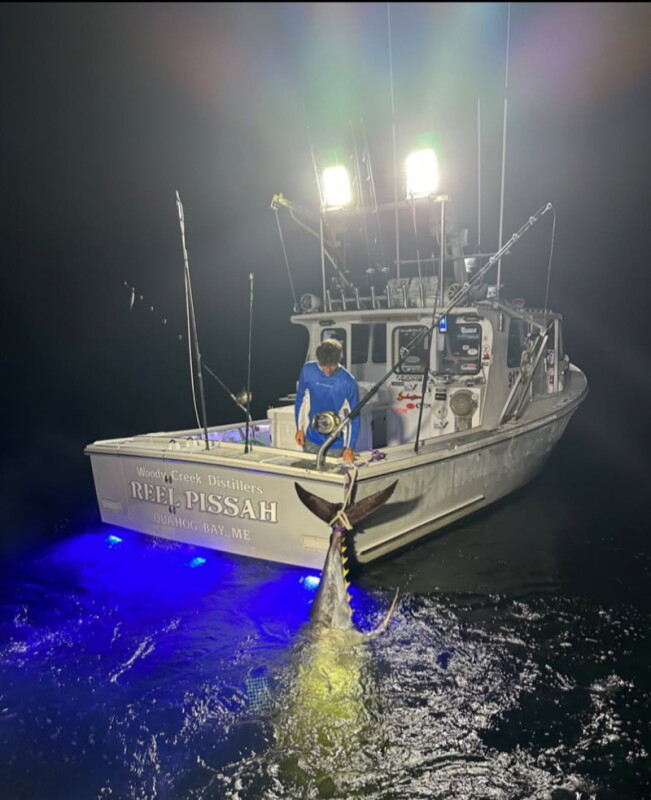
Durabrite first began making lights for the oil fields in Alberta, Canada, but the brand has found its home on fishing vessels of the United States. As bluefin tuna season gets underway on the East Coast, Durabrite has sought to raise interest in its deck lighting systems by sponsoring a series of tuna webinars open to all. The first event took place on July 8, with Walter Golet, a professor who runs the Pelagic Fish Lab at the University of Maine.
Golet offered the almost 200 listeners insights about the biology and behaviors of these iconic fish, such as their ability to keep warm and swim at incredible speeds. As Golet explained, bluefin are one of around 24 fish species that can keep at least one part of their bodies warm. For the bluefin, it's primarily their swimming muscles, brain, and eyes that stay warm. The fish’s gills and heart, Golet notes, stay at ambient temperature.
“Because of the large surface area of the gills, it would take too much energy to keep them warm,” he said.
Golet also gave a brief history of bluefin tuna fisheries dating back more than 10,000 years – from the ancient Mediterranean trap and harpoon fisheries to the modern fisheries of the western Atlantic, including the rise of bluefin tournaments.
“Canada and the U.S had tournaments for decades,” Golet said, noting that the Bailey’s Island tournament in Maine began in 1938. “In the 1930s, people came from all over the world to compete in these tournaments.”
He also described several aspects of bluefin biology that were of particular interest to fishermen, such as the ability of these fish to identify color. That’s where Durabrite shines, says Durabrite president and co-founder Michael Morris.
“The tuna fishermen are using 5,700 kelvin lights and pointing them aft,” Morris says. “When we run them through a diffuser, it gives them an 80-degree spread and maintains 95 percent efficiency. And they’ve found that the baitfish like that color. A lot of guys are using our mini series or pro series, and some are mounting nanos port and starboard, so they don’t lose any fish trying to gaff them in the dark.”
Morris has two more webinars with Dr. Golet planned for August. “The next one is going to be on management,” he says. “Dr. Golet is going to talk about quotas and how allocations are established. Then the third one is going to be on behavior.”
While the Durabrite webinars share valuable and interesting knowledge with fishermen, the idea is also to introduce them to the Durabrite brand. “Guys used to have to run gensets 24/7 to get this kind of light,” says Morris. “Our lights can run off a battery for weeks, that’s what has propelled our brand. Boats without big gensets can now have a level of light they never had before, and the lights are just sipping electricity, so there’s plenty to share with other electronics.”