

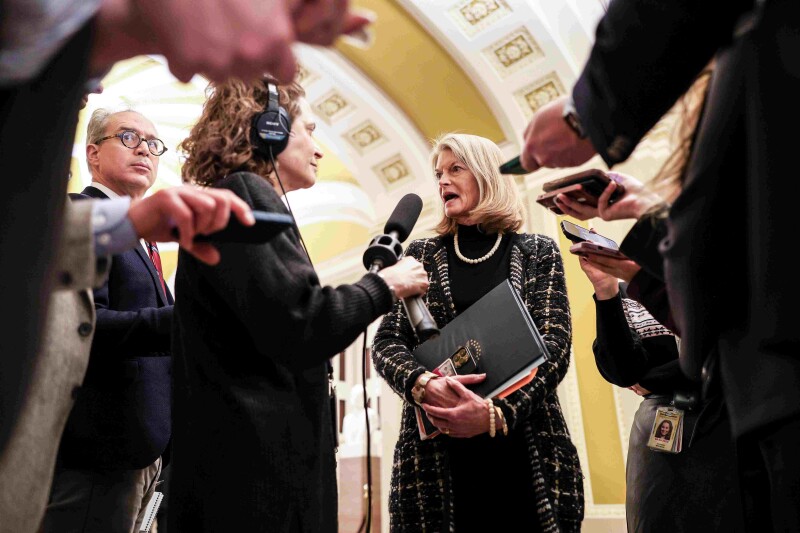
U.S. Senator Lisa Murkowski (R-Alaska) says key fisheries, science, and coastal priorities for the state were protected in the Fiscal Year 2026 appropriation “minibus” bill as Congress works to avoid a Jan. 30 federal funding lapse.
The package combines the Commerce, Justice, Science, Energy and Water Development, and Interior and Environment bills, completing roughly half of the FY26 appropriations process. Murkowski said the legislation safeguarding funding is critical to the state’s economy, fisheries, and coastal communities.
“While tough choices were made, we protected the priorities that matter most to Alaskans: our fisheries, public safety, energy security, Arctic research, and coastal infrastructure,” Senator Murkowski said. “This is exactly why the regular order appropriations process matters—it allows us to come together and build a product through compromise that meets the needs of our people and communities.”
Fisheries and NOAA priorities
Within the Commerce, Justice, Science portion of the bill, Murkowski focuses on strengthening Alaska’s fisheries amid competitive global markets, rising costs, and declining stocks. The legislation includes a $7 million increase for fisheries data collections, surveys, and assessments, which NOAA relies on for fisheries management and conservation.
Funding for the Fishery Survey Contingency Fund would increase by $2 million, bringing the total to $6 million to help ensure stock assessment surveys remain on track. The bill also provides $10 million for Saltonstall-Kennedy Grants to promote and market U.S. fisheries and fully funds fishery stock assessments, management councils, Sea Grant, and electronic monitoring and reporting.
Additional funding includes $65 million for NOAA vessel recapitalization, maintaining critical shipbuilding capacity necessary for fisheries surveys and Arctic operations. And a $500,000 increase for the Pacific Salmon Treaty, funded at $42 million, supporting cooperative fishery management between the United States and Canada.
Targeted Alaska investments include $3.5 million for the Bristol Bay Science and Research Institute to conduct in-season genetic analysis aimed at reducing Western Alaska chum salmon bycatch in the Bering Sea pollock fishery, $1.5 million for the University of Alaska Fairbanks to improve salmon counting using drone-borne maritime lidar, and $2 million for the Alaska Fisheries Development Foundation to support the Alaska Seafood Modernization Initiative.
Safety, science, and maritime infrastructure
The bill also boosts ocean and weather monitoring, including $5 million for the National Data Buoy Center and $5 million for the Integrated Ocean Observing System, which supports maritime safety and fishermen. Arctic science funding is preserved, including $250 million for the National Science Foundation’s EPSCoR program, which builds local STEM capacity.
On the maritime infrastructure side, the Energy and Water Development bill included $41.6 million for the Port of Nome Modification project, $200,000 for Auke Bay navigation improvements, and $18 million for the National Coastal Mapping Program, with at least $6 million dedicated to arctic coastal mapping.
Murkowski stated that work is continuing to complete the remaining FY26 appropriations bills before the end of the month.