




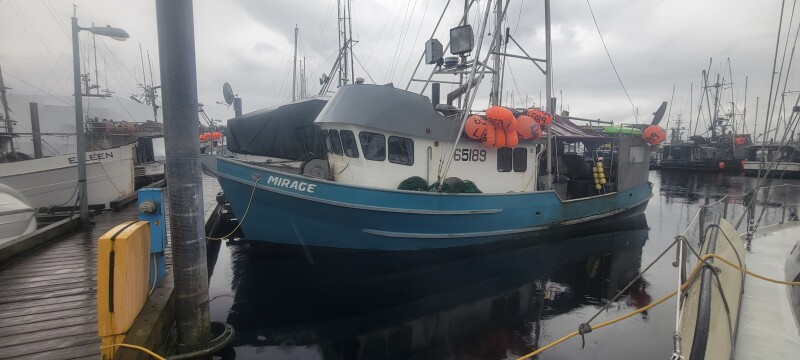
Sea trials are set for mid-January on a vintage Southeast Alaska fishing vessel being equipped with a hybrid engine that will save on diesel fuel and make for a cleaner ocean.
"I'm very excited about it," said Jeff Turner, a veteran commercial harvester in Sitka and owner of the Mirage, a 50-foot longliner-troller.
Rising costs of diesel fuel initially sparked his interest in converting to a hybrid propulsion system, which can accommodate diesel fuel or electric power, but Turner said there are other advantages to hybrid. "Having a clean ocean. Taking care of the ocean around us is our responsibility, and it's quieter, less noise pollution. I can see less impact all around," he said.
Diesel costs stood out, however. "When I was running out west to Seward or Kodiak, fishing in the central Gulf of Alaska, you have to fill the boat (with fish) to make it pencil out well," he said.
Turner is a member of the Alaska Longline Fishermen's Association (ALFA), which got some initial help from the National Renewable Energy Laboratory of the Rockies (NREL). They helped ALFA model energy savings and demands from various systems and researched alternative fuels, said Linda Behnken, a veteran commercial longliner and executive director of ALFA. "They helped us to identify that the hybrid system was the right next step for the ongoing project."
The program is funded by a $500,000 U.S. Department of Energy grant for two hybrid commercial fishing boats and one fully electric mariculture vessel. The second fishing boat, the Energizer, will have only electric propulsion, but also a diesel generator to recharge batteries if needed," Behnken said. "The mariculture boat/skiff will go a shorter distance and can recharge at the end of each day."
The Mirage is a Sitka boat. Energizer, a Juneau boat, will hopefully be back in the water in March, and the mariculture boat, based in Kodiak, will have an electric system installed this spring, Behnken said.
There are currently some 9,000 small commercial boats fishing in the Gulf of Alaska, all burning diesel.
Chandler Kemp, an energy efficiency consultant and founder of Kempy Energetics, said if he had to guess, he would put the average diesel consumption of these vessels at 2,000 to 3,000 gallons — overall, some 20 million gallons of diesel burned annually in Gulf fisheries. "I don't think that there are many boats burning less than 1,000 gallons per year. Also consider that some of the big boats are burning 50,000 gallons per year," said Kemp, a key technical partner for ALFA.
There is growing interest in the use of hybrid engines for getting fishing boats out to the fishing grounds, where they can then switch to electric power and avoid diesel, said Ben Matthys, an energy analyst with Kempy Energetics. Scandinavian countries already have many electric ferries and hybrid diesel-electric boats, Matthys noted.
The Fishermen's Wives Association in Massachusetts is studying their use for lobster and other fleets, as well as tribal entities in Washington state," he said. "These hybrid engines are fairly straightforward. We will be giving some training. Mostly, it's just button pushing. There is some added maintenance, but there should be some net savings with fewer oil changes. We are learning together."
Hybrid engine manufacturers have monitoring systems available, Matthys said. "They remotely monitor the system so they can see if any faults come up. I also intend to be a technician to service them."
The Island Institute in Maine actively promotes and facilitates adoption of electric and hybrid engines along Maine's working waterfront, especially for the lobster fishery, offering grants, training, building infrastructure, and demonstrating the benefits of such engines, including reduced emissions and noise pollution and a cleaner marine environment. The Island Institute also collaborates with the Department of Energy and other partners to support sustainable energy transitions in island communities.
With the right expertise and initial low-cost capital, getting at least 50% of the halibut/black cod fleet equipped with hybrid engines is achievable, unless an alternative fuel becomes feasible first, Behnken said.
"Future funding will depend on the commitment of our country/state to renewable energy transition," she said. "The state's green bank will loan on hybrid systems once it is capitalized. Spruce Roots Energy Bank will lend on hybrid systems for Southeast Alaska-based fishermen." Meanwhile, ALFA will keep building expertise in Sitka and looking for additional resources, she said.
.jpg.small.400x400.jpg)
