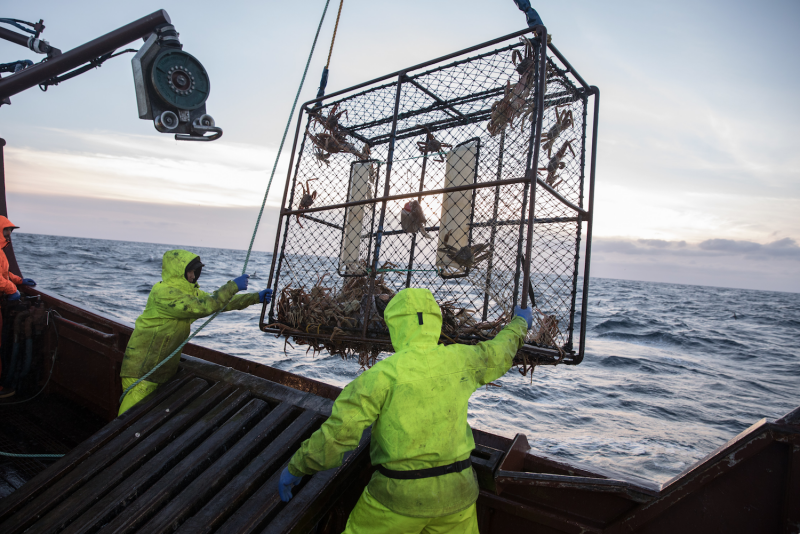
Alaska’s commercial Bering Sea snow crab fishery kicked off its second season of the year with doubled catch limits – a positive sign for harvesters after the fishery was closed for multiple years due to a mortality event.
The Bering Sea snow crab stock plummeted suddenly in 2021, with researchers later placing much of the blame on a marine heatwave and unfavorable ocean conditions. Regulators ended up closing the fishery for multiple years to allow the population to recover, and in 2024, they determined that the stock had improved enough to allow a limited harvest. The Alaska Department of Fish and Wildlife (ADF&G) approved a 4.7-million-pound harvest for the 2024-25 season.
After a successful first season back, ADF&G has roughly doubled the catch limit for the 2025-26 season. Regulators have set a total allowable catch (TAC) of 9.3 million pounds for the season, which kicked off October 15 and is slated to run through May.
ADF&G initially set a base total allowable catch for snow crab at 8.3 million pounds, but after discovering an “unprecedented high abundance of hybrid Chionoecetes crab in NOAA Fisheries’ annual survey, they opted to increase the TAC by 1 million pounds to allow vessels to target the hybrid crabs.
“In coordination with the Bering Sea crab industry, ADF&G expects that vessels target 1 million pounds or 11 percent of the 9.3-million-pound Bering Sea District snow crab TAC in the portion of the Bering Sea District with the highest survey abundance of hybrid Chionoecetes crab,” the department explained.
In addition to the high number of hybrids, the NOAA Fisheries survey revealed “strong increases of mature male and female abundance” and a “modest increase in industry-preferred males but large males still at low levels,” according to an ADF&G presentation to the industry.
Commercial fishers will also be allowed to catch more Bering Sea tanner crabs and Bristol Bay red king crabs after ADF&G announced slight increases to both TACs.
The Bristol Bay red king crab TAC increased from 2.3 million pounds to nearly 2.7 million pounds, while the Bering Sea tanner crab TAC increased to nearly 11.3 million pounds – roughly twice as high as last year. According to ADF&G, this is the largest tanner crab fishing season since 2015.
“As crab harvesters and industry, we’re really encouraged by the positive signals that we saw come out of the bottom-trawl survey with regards to crab, particularly for snow crab,” Alaska Bering Sea Crabbers Science Advisor and Policy Analyst Cory Lescher told the North Pacific Fishery Management Council, according to the Alaska Beacon. “We’re still concerned that all the stocks are low, but we’re seeing at least a step in the right direction with some of these results that we saw.”
This article is republished with permission from SeafoodSource. Read more here.