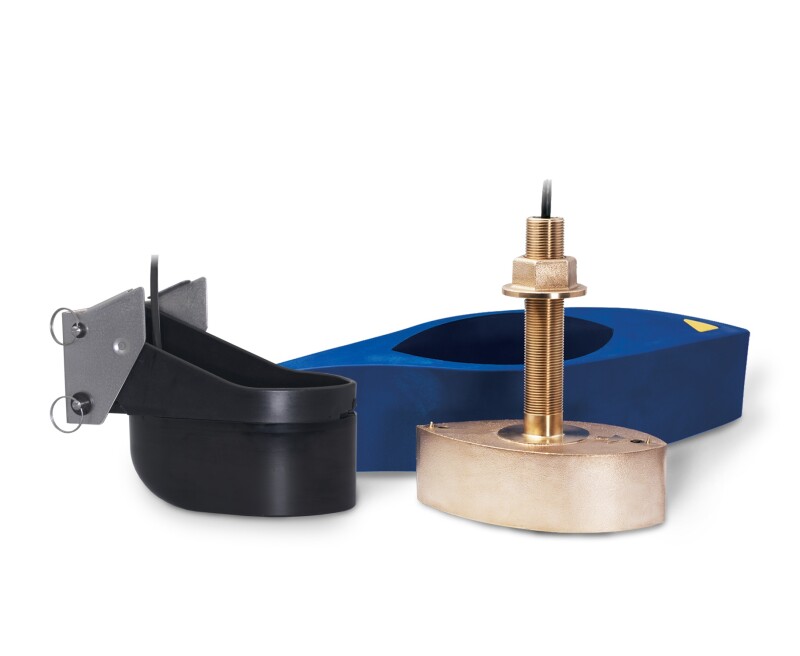
Sonars have been built to look everywhere in the sea, and Airmar produces many of the transducers that companies like Furuno, Simrad, and others use with their products. “The newest model we have is the Medium Ultra-Wide Chirp transducer,” says Craig Cushman, director of marketing at Airmar Technology. “That’s a 60-100 kHz transducer that delivers good resolution down to 1300 ft.”
While the new medium ultra-wide has only a 16-degree beam fore and aft, the beamwidths are as wide as 73-degrees port/starboard. “That can be a standalone system for fishermen looking for deeper water schools,” says Cushman. “Or we have models that combine medium frequency ultra-wide with a high-frequency wide-beam transducer that also delivers awesome target resolution down to 500 feet. So, if you’re a tuna purse seiner, it’s easy to know if you’re looking at tuna or a school of baitfish. Then the medium ultra-wide lets you look around and see what may be off to the sides of the boat as well as bottom contours.”
The new Medium Ultra-Wide Chirp transducer fills a gap in the Airmar line of transducers. “It gives you a massive swath going deeper than our standard high-frequency Chirp transducer,” says Cushman. “But with better resolution than our low-frequency transducers.”
According to Cushman, it was fishermen targeting tilefish, grouper, and queenfish who asked for the medium ultra-wide. “They wanted to reach these deeper water fish with the highest frequency possible,” he says. “Low frequency tends to average the bottom and close holding fish, so we created this concave array at 60 to 100 kHz, which covers a larger area and provides clearer target separation than low frequency models.”
Although initially developed for hook-and-line fishermen, Cushman notes that the medium ultra-wide can benefit other fishermen, such as salmon seiners and Acadian redfish trawlers. “A transducer is a fishing tool,” he says. “The medium ultra-wide is going to be particularly good for any fish but really shines in water between 500 and 1300 feet.”
Some of the electronics companies that utilize Airmar transducers, such as the aforementioned Furuno and Simrad, also make their own transducers. “When you get over 1 kW of power, they partner with us,” says Cushman. “And we sometimes build transducers exclusively for some of these companies. But we mostly build transducers that virtually every electronics brand can use.”
When Airmar builds a transducer, Cushman explains, the transducer has a code called Transducer ID® that electronics manufacturers use to communicate with their equipment. “When we develop a new transducer, we share a unique digital ID with the electronics manufacturers,” he says. “They put that ID information into their sounder software so that when the transducer is connected, there is an electronic handshake that ensures all the right parameters are set for flawless integration.”
All the top marine electronics companies have been shaking hands with Airmar transducers for decades now, and since July of 2025, they have been connecting with the company’s Medium Ultra-Wide. Cushman notes that the new line includes through-hull and transom-mounted versions in both single frequency (MW) and dual frequency (MWHW).